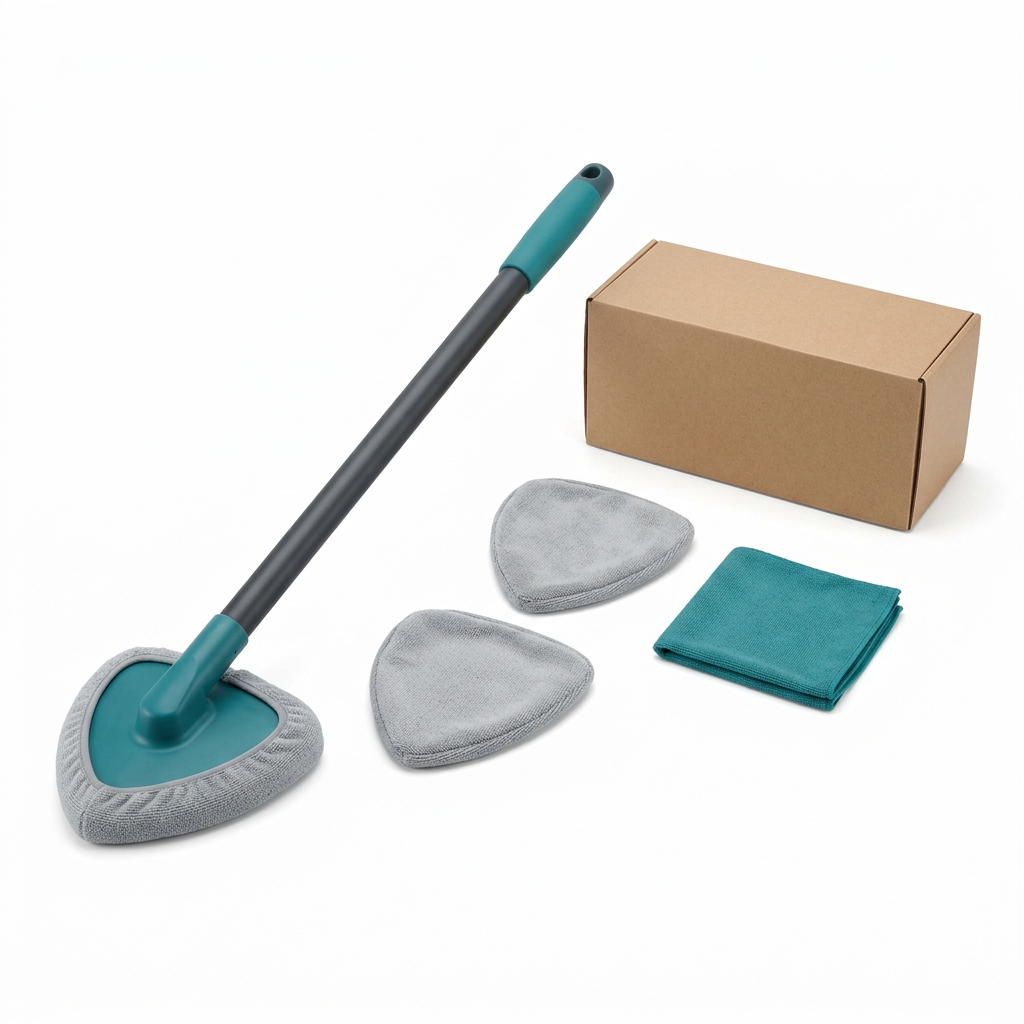
Interior Windshield Cleaning Tool Kit with Long Handle, Triangular Cloth-Covered Head, Two Spare Bonnets & Detail Cloth for Car Glass Care
Interior Windshield Cleaning Tool Kit with Long Handle, Triangular Cloth-Covered Head, Two Spare Bonnets & Detail Cloth for Car Glass Care
Couldn't load pickup availability

🪟 The Inside of the Windshield Deserves Its Own Plan
You have cleaned the outside glass, put the cloth away and stepped back to look. Then the light changes, and you notice a different mark: something on the cabin side of the windshield. It is a familiar moment, especially where the glass slopes away above a deep dashboard.
This proposed windshield cleaning kit approaches that awkward space with a fixed long handle and a rounded triangular, cloth-covered head. Two spare head bonnets and a separate detail cloth complete the planned collection. The idea is to introduce a different tool shape into an approved glass-care routine, not to promise that every windshield becomes effortless to reach.
What Makes Interior Glass a Different Task?
Working inside the cabin means paying attention to more than the glass alone. The dashboard sits below. Cameras, sensors, mirrors, trim and electrical components may be close by. A broad hand movement that feels simple outside the vehicle can become awkward inside it.
That is why this product concept is organized around approach, contact and cloth management. The handle is intended to offer an alternative hand position; the cloth-covered head provides the proposed contact surface; the spare bonnets create an opportunity to separate used and clean accessories. Every part still needs checking against the actual glass and vehicle instructions.
Approach: A Fixed Handle, Not an Extension System
The reference design uses one charcoal shaft with a teal grip and a teal head connection. It is a fixed-length concept. No telescoping section, adjustable reach range or folding mechanism is included or implied.
The final shaft length, grip dimensions, weight and connection strength must be measured on the supplied tool. A longer handle does not establish compatibility with every dashboard depth or windshield angle. Assess whether the actual tool can be positioned without pressing against trim, forcing your posture or contacting nearby equipment.
Use the tool only while the vehicle is safely parked. It is not intended for wiping glass while driving, operating controls or reaching around an occupied driver's position. Stop if a location cannot be accessed comfortably and safely using the approved method.
Contact: A Rounded Triangular Head
The concept's most distinctive detail is its triangular outline with rounded corners. The close-up image shows that shape covered by a grey cloth bonnet. It is a proposed design direction rather than proof that the head reaches every corner or conforms to every curve.
No pivot range, pressure distribution, scratch resistance or edge-cleaning performance has been established. Do not use the hard head, connector or handle directly against glass. Confirm that the approved bonnet is correctly fitted and free from grit before any permitted contact.
If the bonnet loosens, the head catches or you notice resistance, stop and inspect rather than increasing pressure. A manual cleaning tool is not a scraper for stubborn deposits, an ice remover or a repair device for damaged glass.
🧺 Cloth Management: Give Each Piece a Role
The Fitted Bonnet
One grey bonnet appears fitted to the head in the reference image. Its job in the proposed design is to cover the cleaning face. Exact attachment, fabric composition, thickness and edge construction require supplier confirmation before the final page can describe them as specifications.
The Two Spare Bonnets
Two matching spare bonnets are planned as separate accessories. They offer a way to keep an approved clean cover available rather than continuing with a visibly soiled one. This is not a promise of a particular number of cleaning sessions, stain-removal performance or compatibility with third-party heads.
The Separate Detail Cloth
The teal square cloth is a distinct part of the kit. Its intended role must be matched to the confirmed material and surface instructions. Do not assume that a cloth suitable for one area is also appropriate for a tinted film, coated surface, display or camera lens.
A Quiet Morning Glass-Care Check
Imagine the car parked and the cabin clear of loose belongings. Before starting, you inspect the glass in good light, identify any film or coating and read the appropriate care guidance. You check the bonnet for particles and lay the spare pieces somewhere clean, away from the floor.
Where the approved instructions permit, you work on a manageable area rather than forcing the head across the full windshield in one motion. At the end, you inspect the result from a normal seated position and check for residue. The process matters more than an exaggerated before-and-after image.
No cleaning liquid is included. If the approved method requires a separate cleaner, confirm its compatibility with the surface and follow its directions. Avoid spraying toward electronics, sensors or openings. The kit is not a substitute for a vehicle's ventilation, defrosting or demisting systems.
Check the Glass Before Choosing the Tool
- Aftermarket tint or film: obtain explicit compatibility guidance from the film supplier. Do not assume that an approved method for bare glass also suits film.
- Special coatings: follow the coating manufacturer's care requirements and avoid experimenting with unverified materials.
- Sensors and cameras: keep the tool away from housings, lenses and sensitive components unless their instructions specifically permit the method.
- Damaged or loose surfaces: seek appropriate repair or specialist advice rather than using pressure to work around the problem.
No streak-free finish, anti-fog treatment, improved driving safety, universal vehicle fit or removal of every residue is claimed in this draft. Visibility problems should be addressed using the appropriate vehicle guidance, not by relying on an untested accessory.
The Proposed Package, Precisely Explained
The planned contents are one fixed long-handle cleaning tool, three grey head bonnets in total with one shown fitted and two spare, and one teal square detail cloth. The set is intended to arrive in one plain kraft box without a logo. No spray bottle, liquid cleaner, storage pouch or powered component is included.
Final contents, measurements and materials must match the approved supplier sample. Cars, seats, workbenches, clothing and other photography props are not part of the kit.
After Use: Check, Care and Store
Remove used accessories only as directed by the final instructions. Clean and dry the textiles using the verified care method; machine washing, dryer settings and cleaning chemicals are not established here. Inspect the tool connection and bonnet before the next session, and store loose accessories where they cannot interfere with pedals, seat movement or vehicle controls.
A Different Angle on an Everyday Detail
The navy, apricot and teal imagery gives this concept a distinct identity, while the product story stays focused on a specific task: planning care for the inside glass. Once the sample and compatibility information are approved, the listing can present exactly what the tool offers, where it is suitable and how to use the supplied accessories without unsupported promises.